bStocks as Binance collateral: VIP 0–2 must pass a questionnaire first
Cross Margin, Portfolio Margin and Portfolio Margin Pro can now hold bStocks as collateral, though borrowing isn't supported for bStocks tokens for now. A VIP 0–2 account that hasn't passed the questionnaire can't use the related margin features.
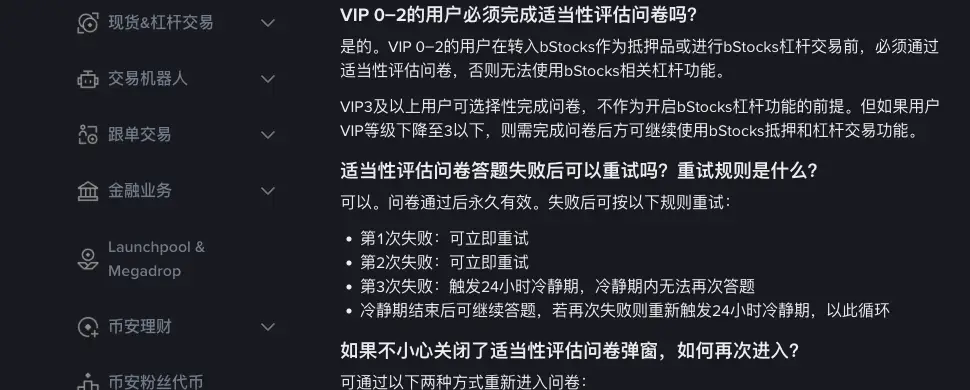
A VIP 0–2 account that opens Binance's margin trading page to move bStocks in as collateral is met by the Suitability Assessment Questionnaire before anything else. The help page is explicit that these accounts must pass the questionnaire before transferring bStocks in as collateral or trading bStocks on margin. Without a pass, the related margin features stay unavailable.
Behind that gate is a change on Binance Margin, which has started accepting some bStocks as collateral, and a set of risk-control rules that VIP 0–2 accounts carry on top of the questionnaire. Binance published this FAQ on 3 July 2026, and the English page was last updated on 24 September.
bStocks on Binance Margin: collateral only, no borrowing for now
Binance Margin now supports some bStocks tokens as eligible collateral assets. They can be used as collateral in Cross Margin, Portfolio Margin and Portfolio Margin Pro, by eligible users in permitted jurisdictions. The current list is on the Margin Data page.
One answer on the page needs pulling out on its own: "Borrowing is not currently supported for bStocks tokens. They can only be used as collateral assets." For any future change, the page points to official Binance announcements. The purpose it gives for posting bStocks is "to enhance capital flexibility".
A separate point is easy to mix up with this one. The spot token itself has no built-in leverage and can't be shorted. Posting the token in a margin account as collateral is another matter, and it's the one dealt with here: the leverage comes from the account, not from the token.
The VIP 0–2 Suitability Assessment Questionnaire: when it appears and how many failures lock you out
Binance frames the rule as protecting user assets and meeting regulatory requirements: VIP 0–2 users must pass the questionnaire before they can use bStocks as collateral or trade bStocks on margin. For VIP 3 and above it's optional. If your level drops below 3, you have to complete the questionnaire to keep going.
On what a pass is worth, the page has one line: "Once passed, the questionnaire is valid." The retry rules after a fail are written as four bullet points; merged into two rows, they look like this:
| Failed attempts | Retry rule |
|---|---|
| 1st and 2nd fail | You can retry immediately |
| 3rd fail | Starts a 24-hour cooldown during which you can't retake the questionnaire; once it ends you can try again, and another fail starts a new cooldown, and so on |
If you closed the pop-up and want to get back to the questionnaire, there are two ways: it appears automatically when you open the bStocks margin trading page, or you can go straight to binance.com/en/margin/bstocks-quiz.
How Binance sorts your other coins into three liquidity tiers
For accounts holding bStocks as collateral, Binance sorts the other crypto assets in the account into three classes by prudential quality tier, assessed on volatility, liquidity, track record and similar factors.
| Tier | Binance's description |
|---|---|
| High-liquidity assets | Assets with a higher collateral ratio and relatively stable prices |
| Medium-liquidity assets | Assets with a moderate collateral ratio and larger price swings |
| Low-liquidity assets | Assets with a lower collateral ratio and significant price swings |
The table isn't fixed. An asset's classification may change over time at Binance's discretion, and the latest classifications are on the Margin Data page. The extra restrictions fall on exactly the medium- and low-liquidity tiers.
Three conditions that must all hold before an account is restricted
Holding bStocks as collateral doesn't mean an immediate restriction. All three of these have to be true at once:
- The VIP level is below 3 and the account holds bStocks as collateral;
- bStocks collateral makes up a significant share of the account's total net asset value after collateral-ratio adjustment;
- Effective leverage on the net exposure to medium- and low-liquidity assets exceeds a specified threshold.
The thresholds and formulas for the last two are in Binance's bStocks Margin Collateral Risk Controls Guide.
Once an account is over those thresholds, the system "may impose restriction measures, including but not limited to" these four:
- No more bStocks can be transferred into the account;
- Buying or borrowing medium- and low-liquidity assets is prohibited (repaying existing liabilities excepted), though transferring in suitable assets to lower liquidation risk is allowed;
- No new futures positions can be opened in the Portfolio Margin account (reducing positions only);
- Auto top-up is paused for bStocks and for medium- and low-liquidity assets.
Look closely at which rule blocks what. High-liquidity assets aren't covered by the ban on buying and borrowing and can still be traded normally. The third rule makes no distinction between tiers, though: once the account is restricted, futures positions in any asset in the Portfolio Margin account can only be reduced, not added to. Binance also specifies that these restrictions apply only to Cross Margin and Portfolio Margin accounts that are VIP 0–2 and hold bStocks collateral. Other margin accounts without bStocks aren't affected, and other sub-accounts can trade as usual.
Getting the restrictions lifted: no application, but you have to act
All restrictions are lifted automatically once the account is back at the required risk level. Binance lists four ways to get there:
- Reduce exposure to medium- and low-liquidity assets: close positions, sell or transfer out, repay liabilities, or close futures positions in the Portfolio Margin account;
- Transfer in high-liquidity assets to improve the collateral mix;
- Upgrade to VIP 3, after which the account is no longer subject to these risk restrictions;
- Transfer out some bStocks to bring their share below the threshold. This one comes with a reminder: "Please ensure your account maintains a safe margin level during the transfer to avoid liquidation."
Take that last reminder seriously. The bStocks are themselves collateral in this account. Whatever you move out takes its collateral value with it, and an account that's already tight may hit the liquidation line first.
Then there's the matter of how you'd know the account has been restricted. An email goes to your registered address both when a risk restriction is triggered and when it's lifted, so keep that address current. The system monitors the account continuously and lifts the restrictions automatically once the trigger conditions no longer hold; there's nothing further to submit.
Four things to think through before posting bStocks as collateral
Collateral ratios change. Different bStocks tokens may have different collateral ratios, and the ratios can be adjusted at any time according to market conditions. Go by the current figures shown on the Margin Data page and related pages.
The index price depends on the US trading session. The index price for bStocks used as margin collateral is calculated differently depending on the US stock market trading session. The details are in Binance's bStocks Tokenized Securities Collateral Index Price Methodology.
There's a maximum collateral amount. Use as collateral is subject to the platform's maximum collateral quantity.
A risk restriction doesn't rule out liquidation. Binance's own wording is: "Risk restrictions do not forcibly close your existing positions. However, forced liquidation may still occur if your margin level breaches the liquidation threshold, regardless of whether risk restrictions are applied on your account."
None of this settles whether stock tokens are safe to hold; the risks of the token itself are a separate question.
bStocks collateral FAQ
I dropped from VIP 3 to VIP 2 with bStocks already posted in my margin account and no questionnaire done. What happens?
Binance covers only two points. Once your VIP level falls below 3, you have to complete the questionnaire before you can keep using bStocks as collateral and trading them on margin. And a change of level automatically applies or removes the corresponding risk controls. How the bStocks already posted are treated before you take the questionnaire isn't addressed in this FAQ.
If the stock behind a bStocks token pays a dividend or splits, how is the part I've posted in a margin account handled?
The collateral FAQ doesn't go into it. Binance puts the effect of corporate actions (dividends, splits, reverse splits) on bStocks in the corporate actions section of its separate Frequently Asked Questions on bStocks, and the handling has to be read from that section.
My account is already restricted. Can I just sell my bStocks for another coin?
On trading while restricted, Binance's answer is: "You may reduce existing positions to lower risk, but you cannot open new positions, borrowings, or futures positions in medium-liquidity or low-liquidity assets." High-liquidity assets remain unrestricted. So watch what you switch into: a high-liquidity asset can still be traded normally, while a medium- or low-liquidity one runs into the prohibition on buying or borrowing those assets. If you transfer bStocks out instead of selling them, the page's reminder is to keep the account at a safe margin level during the transfer, to avoid liquidation.
The Binance help page this guide draws on
The English Help Center page shows a publication date of 2026-07-03 and an update date of 2026-09-24.
- Binance Help Center: Frequently Asked Questions on Binance bStocks as Collateral Assets