What does FPSL stock lending on Binance change about your shares?
Working from the master lending agreement on Binance's legal page, this goes item by item through what happens to dividends, voting rights, selling, income and collateral while shares are lent out, and which statements in Alpaca's documentation can't simply be carried over to Binance.
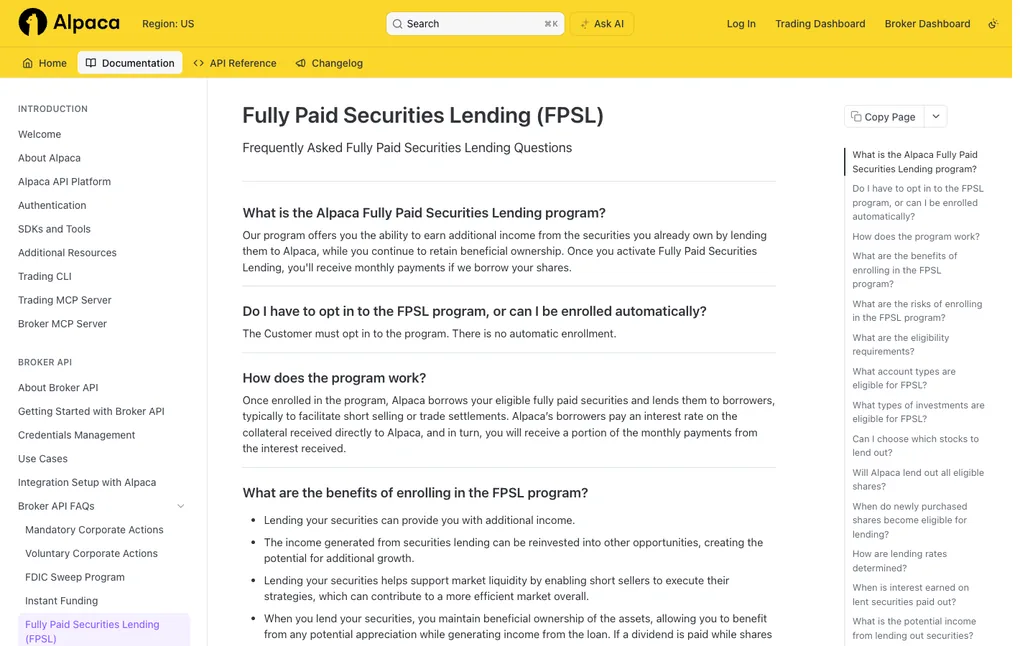
FPSL stands for Fully Paid Securities Lending. Turning it on in Binance's stock trading means agreeing that the settled, fully paid US stocks in your account can be lent to the clearing broker Alpaca Securities LLC, which then lends them on to whoever needs the shares, such as an institution that has to deliver on a short sale. You may get a share of the fees the lending generates.
Whether it's on or off mostly matters during the stretch when a share has actually been lent out. In that period the voting rights sit with the borrower, dividends are replaced by a cash substitute payment, and the lent shares may no longer be covered by the US Securities Investor Protection Act (SIPA); they're secured instead by collateral held at a third-party bank. None of this comes into play while a share isn't on loan, and a share that is on loan can still be sold whenever you like.
Who borrows the shares you lend through Binance FPSL?
The document posted on Binance's legal page is titled Master Securities Lending Agreement for Fully Paid Securities Lending. The borrower is Alpaca Securities LLC, and the signature block names Nest Trading Limited as the lender. The body of the agreement doesn't mention Binance users. Its omnibus account provisions call the customers behind the lender Beneficial Owners, and that's the layer Binance users sit in. Nest Trading Limited lends the shares of its beneficial owners together, in its own name, through one omnibus account, and the agreement states that it is not acting as the beneficial owners' agent.
The omnibus account provisions settle these points:
- Alpaca has no direct contractual, custodial or customer relationship with you and doesn't accept instructions, notices or requests from beneficial owners; everything goes through Nest Trading Limited;
- Alpaca issues confirmations and statements to the lender at the omnibus level only and has no obligation to send beneficial owners statements of their own;
- the economic benefit of the lending fees and the collateral is allocated to each person by Nest Trading Limited, based on its own records and its arrangements with its customers.
Once it has borrowed the shares, Alpaca can lend them on to other brokers or third parties, for purposes such as delivering on short sales and covering failed deliveries, as permitted under the US Regulation T. Alpaca decides when to borrow and which stocks, without asking your consent for each loan or telling you beforehand. For the firms a Binance stock order passes through on its way to custody, see the custody chain in our piece on the SpaceX-linked products on Binance.
Changes to your holding while a share is on loan
If you don't turn it on, none of the shares attributable to you are lent out. The agreement's supplemental terms require the lender, before lending any shares held for you, to obtain the beneficial owner's explicit written or electronic consent and to have you acknowledge a set of risk disclosures covering voting rights, SIPA protection, short-selling uses, collateral arrangements, how income is calculated, tax, recalls and the right to sell, and conflicts of interest. Where these supplemental terms conflict with the other provisions, they take precedence.
Turning it on doesn't guarantee a loan either. The risk disclosure says Alpaca has no obligation to borrow from you, there may be no demand for a given stock in the lending market, and the same stock held by other customers may be borrowed first. Opted in and currently on loan are therefore two different states, and the right-hand column of the table below only applies to the second:
| Item | Not opted in, or opted in but this stock isn't on loan | While this stock is on loan |
|---|---|---|
| Price moves | You bear them as usual | You bear them as usual; you keep economic ownership and the contractual right to get the shares back, and that right is against the lender, Nest Trading Limited, not Alpaca |
| Cash dividends | Ordinary holding; the lending agreement doesn't come into it | No dividend directly from the issuer; you receive a cash substitute payment instead, which may be taxed differently from an ordinary dividend |
| Voting and consents | Ordinary holding; the lending agreement doesn't come into it | Exercised by the borrower when the record date or deadline falls within the loan |
| Selling | As usual | You can sell at any time; executing a sell order counts as terminating that loan |
| Extra income | None | You may receive part of the lending fee, in a proportion the lender arranges |
| SIPA protection | Ordinary holding; the lending agreement doesn't come into it | May not apply; secured by collateral instead |
| Which stock is lent, and when it comes back | Not applicable | You can't choose, and you can't recall an individual stock |
Dividends on lent shares become substitute payments
What you get is a cash substitute payment, not the dividend the issuer pays out. The body of the agreement provides that the lender is entitled to all distributions on lent shares as if they had not been lent, with cash distributions paid by the borrower in cash, in the same amount, on the payment date. The risk disclosure puts it to you this way: while shares are on loan you won't receive dividends or distributions, but you're entitled to a cash substitute payment.
Whether to recall the shares before the ex-dividend date is entirely up to Alpaca, and it doesn't guarantee a recall. Some special distributions may not be possible to replicate exactly as a substitute payment; non-cash distributions such as stock dividends are added to the lent shares on the distribution date and returned to you with them when the loan ends.
Tax gets a section of its own in the risk disclosure: substitute payments may be treated differently from ordinary dividends for tax purposes; Alpaca may withhold tax on substitute payments and lending fees unless an exemption applies; and Alpaca doesn't give tax advice and strongly recommends talking to a tax adviser before lending. How a substitute payment is labelled once it reaches your Binance account, and how much tax comes off it, the agreement doesn't spell out account by account; it only goes as far as the lender. If that matters to you, ask Binance support before you turn it on.
When do you get the vote back on a lent share?
The agreement states that during the loan the borrower holds all the rights of ownership in the shares, including the right to pass them on to others, and that the lender gives up voting and consent rights whenever the record date or deadline falls within the loan. Voting rights only come back once the loan has ended and the shares are credited back to your account.
The catch is that you can't pull back one particular stock for one particular vote. The omnibus account provisions give beneficial owners no right to recall, vote or give instructions during the loan, and the risk disclosure also says you have no direct control over when any given stock starts or stops being lent. The only way left to get voting rights back is to opt out of the lending program altogether, and opting out ends all of your open loans at the same time.
For a termination notice sent by the lender, the agreement sets the termination date as the earlier of the stock's standard settlement date and five business days. That clock starts when the lender sends notice to Alpaca. As for how long after you opt out on Binance the lender sends that notice, the supplemental terms say only that it is subject to normal settlement and recall processes. You may not be able to rejoin straight after opting out, either: the restrictions the risk disclosure mentions include not being allowed back in, or having to wait for a period.
Selling a share that's out on loan
Lending doesn't stand in the way of selling. The risk disclosure states that you can sell some or all of your lent shares at any time, without waiting for them to be recalled or to come back to your account, and the supplemental terms require the lender to have a process ready for beneficial owners to sell lent shares. Under the agreement, once a sell order executes, the lender is treated as having given notice of termination, and that loan ends on the settlement date of the sale.
Lending fees accrue daily on each loan, so once a loan ends, that stock stops earning a lending fee. It works the other way too: Alpaca can end a loan at any time and return the shares to your account, for reasons including the onward borrower returning them or Alpaca turning down a request to change the rate. Once they're back, the shares are no longer marked as lent and collateral is no longer held for you.
Calculating FPSL lending income
The lending fee is calculated daily from that day's market value of the lent shares and the lending rate at the time. Rates follow supply and demand in the securities lending market: hard-to-borrow stocks, the heavily shorted ones with little available to borrow, generally earn higher fees. The rate can be fixed or tied to a rate index, and the borrower doesn't have to give notice before changing it. Securities lending is an over-the-counter market without transparent pricing, and Alpaca doesn't guarantee the best rate.
The fee doesn't all go to you. The risk disclosure states that Alpaca, introducing brokers and sometimes custodians within the Depository Trust Company (DTC) system may each take a share; if the collateral earns interest, Alpaca takes part of it first and then decides whether to pass any on to the lender. The proportion that reaches Binance users, and when it's credited, is allocated by Nest Trading Limited according to its records and arrangements; the agreement gives no figures.
Having FPSL on for a long time without receiving anything is also a normal outcome: nobody in the lending market may want the stocks you hold, or other customers' shares of the same stock may have been borrowed first. Don't count this money in your expected returns before you turn it on.
What covers you if Alpaca can't return the shares?
The collateral. Under the supplemental terms, collateral can only be cash, US Treasury bills, US Treasury notes, or other instruments permitted under Rule 15c3-3 of the Securities Exchange Act and agreed to in writing by the lender. It's held at BMO Harris Bank N.A., where 17a-4, LLC, acting as collateral agent, holds the security interest on behalf of the lenders, and it's recorded separately for each lender.
The agreement sets collateral at no less than 102%. According to the risk disclosure, Alpaca's practice is to multiply the closing price of the lent shares by 102%, revalue at the close every business day, and make up any shortfall by the close of the next business day at the latest; Alpaca reserves the right to change this practice, but never below 100%. For example:
- say 10 shares are on loan and the day's closing price is $200: the market value is 10 × $200 = $2,000, so collateral is set at $2,000 × 102% = $2,040;
- the next day the close rises to $220: the market value is $2,200, so collateral should be $2,200 × 102% = $2,244, and the $204 gap is topped up by the close of the next business day at the latest.
The risk disclosure also flags some gaps. Once lent shares leave your account, SIPA may not protect them, and if Alpaca doesn't return the shares, the collateral may be your only source of recovery; if the share price rises on the day Alpaca defaults, the collateral may not be enough. The collateral agreement adds that if there isn't enough collateral to go round, it's shared in proportion to what each lender is owed. And the omnibus account provisions state that collateral is delivered only to the lender, never directly to any individual beneficial owner, so for Binance users this protection only reaches you through Nest Trading Limited.
The risk disclosure also acknowledges that short selling may put downward pressure on a stock's price, while you still bear that stock's price moves throughout the loan.
Parts of Alpaca's FPSL FAQ that apply to Binance users
The custodian, Alpaca, has an FPSL FAQ page of its own in its documentation, written for customers who open accounts directly with Alpaca. The points that line up with Binance's agreement are: you have to opt in yourself and won't be enrolled automatically; you can't choose which stocks are lent; you have no voting rights while shares are on loan; dividends are replaced by substitute payments; and selling ends that loan.
Other items are Alpaca's arrangements for its own customers, so don't treat them as Binance rules: the eligibility criteria where meeting any one of four is enough (one of them a $2,500 account balance), interest credited on the last settlement day of the following month, interest calculated on a 360-day year, and the income example on that page. Binance users go through Nest Trading Limited's omnibus account, so eligibility, the revenue split and crediting dates all depend on the arrangements at that level.
None of the above is investment or tax advice.
The FPSL agreement and custodian documentation
- Binance legal page, FPSL agreement-Alpaca (with the full master lending agreement and its schedules embedded)
- Alpaca documentation: Fully Paid Securities Lending (FPSL)